Human Orbital Spaceflights

International Flight No. 48Soyuz 13KavkazUSSR |
|
Launch, orbit and landing data
|
 |
|||||||||||||||||||
alternative crew photo |
alternative crew photo |
|||||||||||||||||||
alternative crew photo |
alternative crew photo |
|||||||||||||||||||
alternative crew photo |
alternative crew photo |
|||||||||||||||||||
Crew
| No. | Surname | Given names | Position | Flight No. | Duration | Orbits | |
| 1 |  |
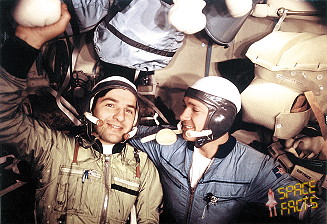
Klimuk | Pyotr Iliyich | Commander | 1 | 7d 20h 55m 35s | 127 |
| 2 | |
Lebedev | Valentin Vitaliyevich | Flight Engineer | 1 | 7d 20h 55m 35s | 127 |
Crew seating arrangement
|
 |
|
||||||||||||
Backup Crew (only "on paper")
 |
 |
|||||||||||||||
alternative crew photo |
Backup Crew (in fact)
|
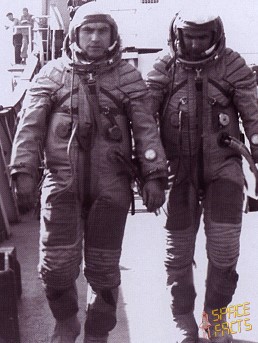 |
Hardware
| Launch vehicle: | Soyuz (No. S15000-28) |
| Spacecraft: | Soyuz 13 (7K-T No. 33) |
Flight
|
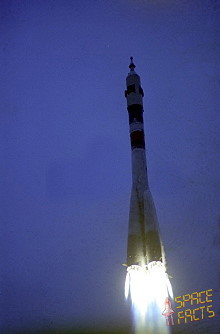
Launch from the Baikonur Cosmodrome; landing
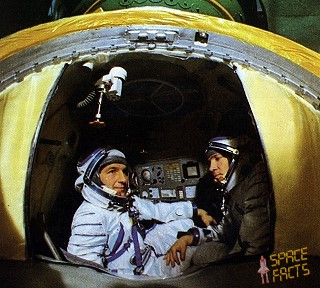
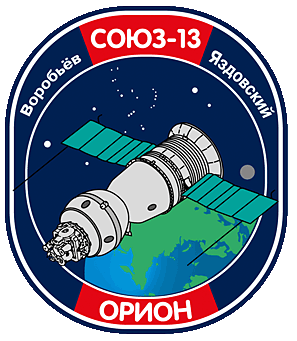
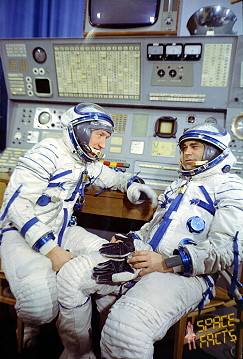
200 km southwest of Karaganda. Lev Vorobiyov and Valeri Yazdovsky were assigned for Soyuz 13, but the crew members had personal differences and the planned prime crew was then grounded. According to a Russian source Vorobiyov himself told that after the crew was replaced, he and Yazdovsky refused to duplicate and withdrew from further flight training. Therefore, they remained stand-ins only "on paper." In fact, the understudies were Kovalyonok-Ponomaryov.
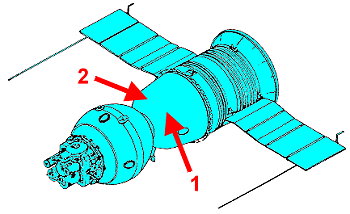
October10, 1973: The crews for the next autonomous flight of the Soyuz 13 spacecraft have been reorganized. The first crew, Vorobiyov-Yazdovsky, remains unchanged. Vladimir Lebedev has been appointed to Klimuk's backup crew, replacing Yuri Ponomaryov. The reshuffle is based on the results of the preliminary tests. Additionally, Yuri Ponomaryov does not fit in the cosmonaut seat.The instructors also have complaints about the first crew. They seem unable to communicate properly with each other during complex operations. Everyone is trying to control the situation. So far, however, no action has been taken against them. November 20, 1973: The comprehensive training for the second autonomous flight was completed at the cosmonaut training center, and the backup crew achieved outstanding results. They also demonstrated a higher level of training throughout the entire preparatory training cycle. However, the main crew, Vorobiyov and Yazdovsky, faced considerable challenges.Yazdovsky had taught space science to the first cosmonaut corps, but his two attempts to join himself had failed. Finally, in 1969, on his third attempt, he was accepted into the training group. Just two years later, he was part of the core crew training for the Soyuz 13 mission.Yazdovsky's self-confidence was boundless. He was convinced that his training level was significantly higher than that of all the other candidates. He needed only two or three training sessions and he would be ready to fly. In fact, he considered the training at the cosmonaut training center a complete waste of time. A specialist of his caliber could procure everything necessary for a flight from the design bureau. Under these circumstances, compromises within the crew were, of course, unthinkable. All problems were solved with principled determination. Vorobiyov and Yazdovsky completed 14 full training sessions in the Soyuz spacecraft simulator, but failed completely on the fifteenth final exam. The commission had never given the crews a failing grade before, but this time the instructors felt compelled to do so. In the final phase before re-entry into Earth's atmosphere, the crew members donned their spacesuits, and Yazdovsky was tasked with closing the hatch between the descent module and the habitat module. While not particularly complex, this process is crucial: the habitat module separates before re-entry, and if the hatch isn't tightly sealed, the descent module will connect directly to the vacuum of space. This connection isn't made through a valve like the one used by Dobrovolsky's crew, but through a hatch 800 millimeters in diameter. Therefore, the hatch's closure is monitored by three sensors spaced 120 degrees apart and three signal lights. As Yazdovsky closed the hatch, the strap became caught between the hatch and the outer hull. One of the lights illuminated. Instead of reopening the hatch, checking it, and then closing it again, Yazdovsky decided to use force and broke the control stick in the process. That ended his mission. He continued his work without reporting the incident to the instructor. Vorobiyov, who knew Yazdovsky's intolerance of supervision, let alone criticism, neither demanded a report nor monitored his actions. As a result, the spacecraft's entire air supply was cut off, which in a real flight would have meant the immediate death of the crew. V. Shatalov liked Vorobiyov and insisted on a re-examination. Again, serious errors were made due to the engineer's overconfidence and the crew's lack of coordination. During the re-examination, the instructor reported, "With three errors, the grade should be below C." Yazdovsky stubbornly disagreed and insisted on the examiners' incompetence. He argued that the simulated situations could not occur in flight. He was provided with a recording of all communication and telemetry data. His colleagues tried to persuade him, but to no avail. He remained steadfast. The experts agreed: This crew was not fit to fly. The final decision rested with the State Commission. December 07, 1973: The State Commission made its decision regarding the crews. Vorobiyov and Yazdovsky were officially relegated to the rank of reserve crews due to psychological incompatibility.
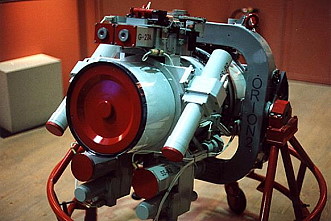
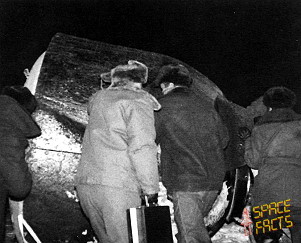
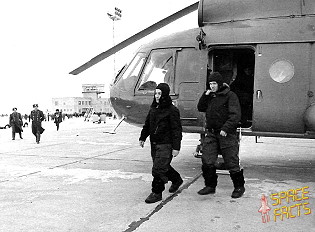
On board was the large Orion 2 astrophysical camera. The crew performed astrophysical observations of stars in the ultraviolet range with this camera. The Orion 2 Space Observatory, designed by Grigor Gurzadyan, was operated by crew member Valentin Lebedev. Ultraviolet spectrograms of thousands of stars to as faint as 13th magnitude were obtained by a wide-angle meniscus telescope of the Cassegrain system, with an aperture diameter of 240 mm, an equivalent focal length of 1,000 mm, and a 4-grade quartz prism objective. The dispersion of the spectrograph was 17, 28 and 55 nm/mm, at wavelengths of 200, 250 and 300 nm respectively. The first satellite UV spectrogram of a planetary nebula (IC 2149 in Auriga) was obtained, revealing lines of aluminium and titanium - elements not previously observed in objects of that type. Two-photon emission in that planetary nebula and a remarkable star cluster in Auriga were also discovered. Additionally, comet Kohoutek was observed. Spectrozonal Earth photography, testing of on-board systems and biological explorations (OASE 2) in view of later planned long termed missions were other experiments. Some of this experiment should have been done on the Salyut 2 station, but the station failed in orbit. The Soyuz spacecraft is composed of three elements attached end-to-end - the Orbital Module, the Descent Module and the Instrumentation/Propulsion Module. The crew occupied the central element, the Descent Module. The other two modules are jettisoned prior to re-entry. They burn up in the atmosphere, so only the Descent Module returned to Earth. The deorbit burn lasted 188 seconds. Having shed two-thirds of its mass, the Soyuz reached Entry Interface - a point 400,000 feet (121.9 kilometers) above the Earth, where friction due to the thickening atmosphere began to heat its outer surfaces. With only 23 minutes left before it lands on the grassy plains of central Asia, attention in the module turned to slowing its rate of descent. Eight minutes later, the spacecraft was streaking through the sky at a rate of 755 feet (230 meters) per second. Before it touched down, its speed slowed to only 5 feet (1.5 meter) per second, and it lands at an even lower speed than that. Several onboard features ensure that the vehicle and crew land safely and in relative comfort. Four parachutes, deployed 15 minutes before landing, dramatically slowed the vehicle's rate of descent. Two pilot parachutes were the first to be released, and a drogue chute attached to the second one followed immediately after. The drogue, measuring 24 square meters (258 square feet) in area, slowed the rate of descent from 755 feet (230 meters) per second to 262 feet (80 meters) per second. The main parachute was the last to emerge. It is the largest chute, with a surface area of 10,764 square feet (1,000 square meters). Its harnesses shifted the vehicle's attitude to a 30-degree angle relative to the ground, dissipating heat, and then shifted it again to a straight vertical descent prior to landing. The main chute slowed the Soyuz to a descent rate of only 24 feet (7.3 meters) per second, which is still too fast for a comfortable landing. One second before touchdown, two sets of three small engines on the bottom of the vehicle fired, slowing the vehicle to soften the landing. The recovery of the capsule was problematic because of a snowstorm. |

Photos
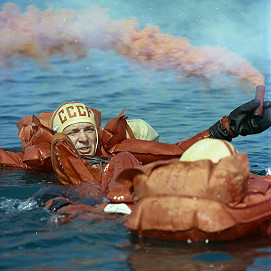 |
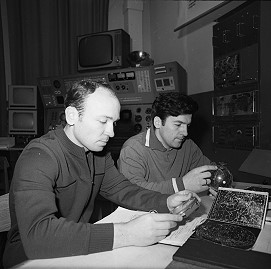 |
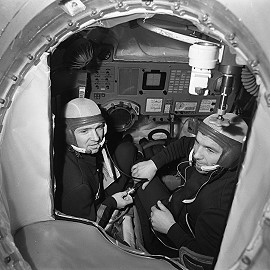 |
 |
 |
 |
 |
 |
 |
| © |  |
Last update on March 20, 2026.  |
 |