Resident Crews of the Chinese Space Station Tiangong

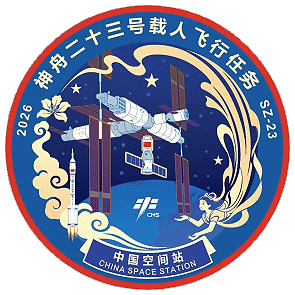
Tiangong: Expedition 11 |
|
 |
|
Crew, launch- and landing data
| No. | Nation | Surname | Given names | Position | Spacecraft (launch) |
Launch date |
Launch time |
Spacecraft (landing) |
Landing date |
Landing time |
Mission duration |
| 1 |  |
Zhu | Yangzhu | Commander (Zhilingzhang) | Shenzhou-23 | 24.05.2026 | 15:08:36.452 UTC | UTC | |||
| 2 | |
Zhang | Zhiyuan | Astronaut 2 ((Hángtian yuán èr) | Shenzhou-23 | 24.05.2026 | 15:08:36.452 UTC | UTC | |||
| 3 | |
Li | Jiaying | Payload Specialist (Zaihe Zhuanjia) | Shenzhou-23 | 24.05.2026 | 15:08:36.452 UTC | UTC | |||
| 4 | |
Astronaut | UTC | UTC | |||||||
| 5 | |
Astronaut | UTC | UTC | |||||||
| 6 | |
Astronaut | UTC | UTC |
Expedition Report
|
Expedition 11 began with undocking of
Shenzhou-22
on May 29, 2026. Shenzhou-23 spaceflight mission's three astronauts have conducted their first in-orbit medical rescue training since arriving at China's Tiangong space station. The training aimed to help the astronauts, Zhu Yangzhu, Zhang Zhiyuan and Li Jiaying, familiarize themselves with rescue operation techniques and force application characteristics under microgravity conditions. In addition to the medical training, the crew has been engaged in a wide range of scientific experiments. They utilized a space Raman spectrometer to study the relationship between gut microbiota and nutritional metabolism under long-duration spaceflight conditions. Behavioral experiments on visual motion processing and intuitive physics in microgravity were performed, exploring how gravity affects visual information processing and how long-term spaceflight impacts intuitive physics perception. The crew also conducted in-orbit emotion recognition and emergency decision-making capability assessments. Inside the Chinese space station, 400 kilometers away, the Shenzhou-23 crew is methodically carrying out various in-orbit tasks. Let's take a closer look. Three taikonauts, in collaboration with ground-based researchers, completed the in-cabin assembly and testing of the MUSICO instrument as well as its installation outside the space station5. This compact, high-resolution, and high-precision instrument can accurately monitor carbon dioxide and methane concentrations in key low and mid-latitude regions across the globe. It is expected to provide valuable space-based observational data for global greenhouse gas source tracing and ecological and environmental research. Multiple experiments in the fields of microgravity physics and fluid physics are proceeding in an orderly manner. Tasks completed according to plan include experiment cabinet maintenance and alignment operations, the replacement of soft-matter materials, and the swapping of experimental module samples. The crew also replaced experimental samples in the fluid physics experiment cabinet, cleaned the containerless cabinet's experimental chamber, performed maintenance on the motor of the central mechanism, and cleaned the window cover lenses. In addition, a series of experiments on lighting environment factors was conducted. By adjusting and manipulating the lighting environment inside the module and conducting taikonaut performance tests before and after these adjustments, teams investigated the impact of the lighting environment in special spaces on human psychological perception and work efficiency. The crew is diligently carrying out tasks related to the maintenance of the space station complex platform and meticulously cleaning the interior environment to ensure a tidy and safe living and working space. At the same time, they are using relevant equipment to measure their personal noise exposure levels. Shenzhou-23's crew continues to conduct in-orbit health monitoring. Last week, the three taikonauts collected, centrifuged, and stored blood samples. They underwent cardiovascular function tests, intraocular pressure and fundus examinations, and ultrasound scans of multiple body areas. They also completed bone density measurements and used the space body weight scale to measure their body mass while in orbit, comprehensively monitoring physiological changes in the microgravity environment. Additionally, the crew is actively engaging with in-orbit exercise using various equipment to maintain optimal physical and mental health, ensuring the efficient progress of their mission. |
Photos
 |
|
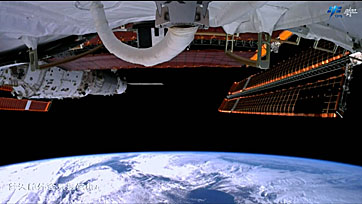
onboard photos |
|
| © |  |
Last update on July 07, 2026.  |
 |